
What Is Thai Massage — and Why So Many People Swear By It
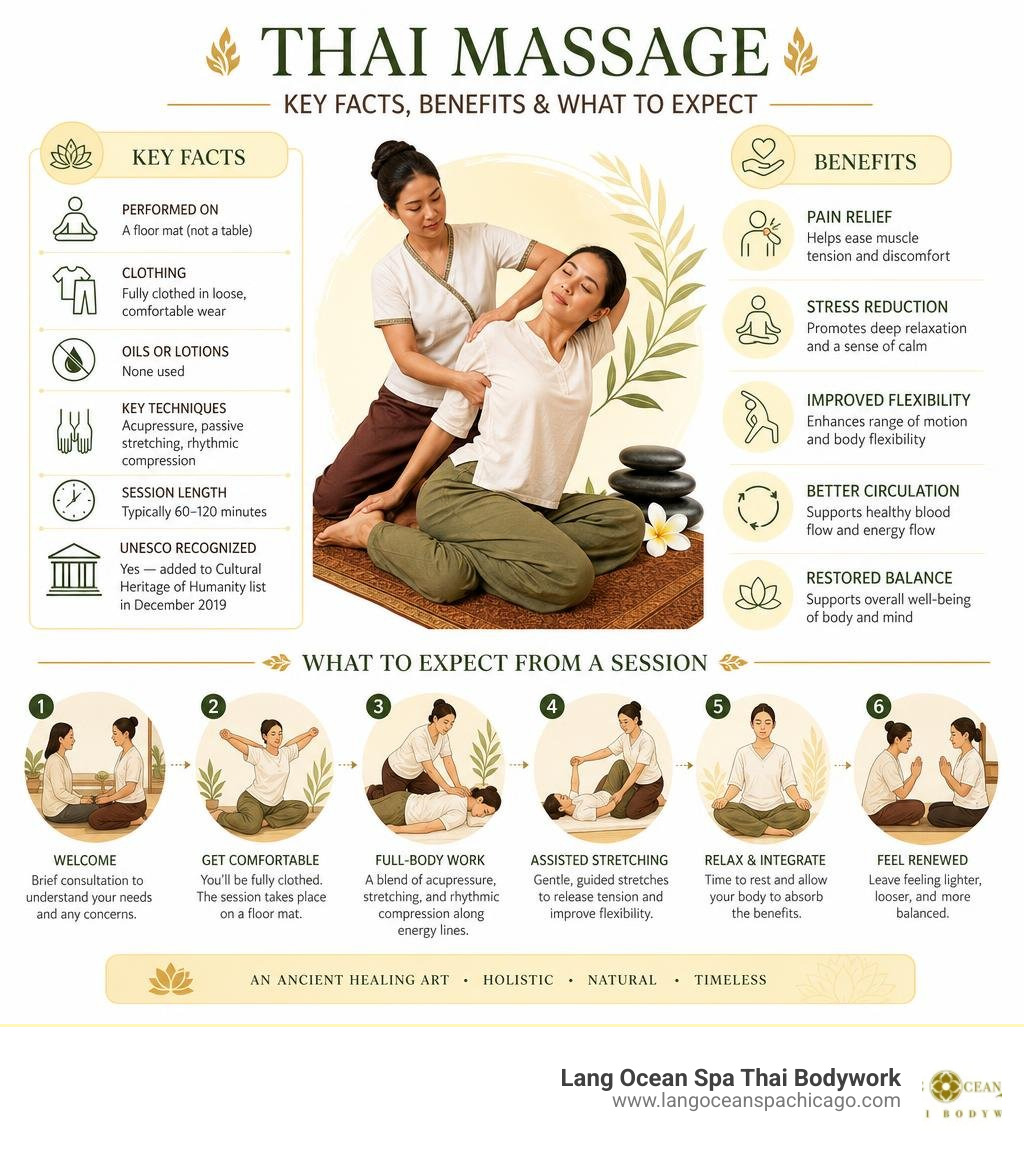
Thai massage is an ancient, full-body therapy that combines acupressure, assisted stretching, and yoga-like movements to release tension, restore energy flow, and leave you feeling both deeply relaxed and refreshed.
Here’s a quick overview:
| Feature | Details |
|---|---|
| Also known as | Nuad Thai, Thai yoga massage, assisted yoga |
| Performed on | A floor mat (not a table) |
| Clothing | Fully clothed in loose, comfortable wear |
| Oils or lotions | None used |
| Key techniques | Acupressure, passive stretching, rhythmic compression |
| Session length | Typically 60–120 minutes |
| Primary benefits | Pain relief, stress reduction, improved flexibility, better circulation |
| UNESCO recognized | Yes — added to Cultural Heritage of Humanity list in December 2019 |
If you spend long hours at a desk, carry chronic tension in your neck and shoulders, or simply feel like your body hasn’t had a proper reset in weeks — you’re not alone. Millions of people deal with the kind of deep, stubborn stress that a standard back rub just doesn’t reach.
That’s exactly where Thai massage stands apart.
Unlike a typical Western massage, Thai massage works with your whole body — not just the surface muscles. Practitioners guide you through a series of assisted stretches and apply targeted pressure along energy pathways called sen lines. The result? A session that feels like a yoga class you didn’t have to do any of the work for.
The practice has roots stretching back over 2,500 years, and in 2019, UNESCO formally recognized it as part of the world’s Intangible Cultural Heritage of Humanity — a testament to just how significant and time-tested this tradition is.
I’m June Liu, founder of Lang Ocean Spa Thai Bodywork in Chicago, where I’ve been helping clients find relief through authentic Thai bodywork techniques since 2016. My passion for Thai massage as a genuine healing practice — not just a luxury treatment — shapes everything we do at Lang Ocean Spa.
What is Traditional Thai Massage and How Does It Work?
To truly appreciate Thai massage, it helps to understand that it is not simply a physical treatment; it is a holistic medical system. Known formally in its home country as Nuad Thai or nuat phaen boran (meaning “ancient-style massage”), this therapeutic modality has been practiced for over two millennia.
The historical origins of Nuad Thai are deeply intertwined with the spread of Buddhism and traditional medicine across Asia. According to historical records and Buddhist scriptures, the founding father of Thai medicine was a legendary figure named Jivaka Komarabhacca (also known as Shivago Komarpaj). He was a highly revered physician in ancient India, a contemporary of the Buddha, and the personal doctor to the Magadha King Bimbisara. In Thai culture, Jivaka is still honored today as the “Father Doctor” and a spirit intermediary whose teachings are invoked before starting a massage session.
As Buddhism migrated from India into Southeast Asia, these ancient medical practices traveled with it. Over centuries, Thai healers synthesized Indian Ayurvedic principles, traditional Chinese meridian concepts, and indigenous Southeast Asian physical therapies into a unified system.
Historically, this knowledge was passed down orally through generations. However, during the Ayutthaya period, royal departments were established to preserve these medical texts. When the capital was destroyed, King Rama I ordered the remaining medical knowledge to be carved into the stone walls of the Wat Pho temple in Bangkok. Wat Pho became the central repository of traditional Thai medical knowledge. In 1955, the first formally approved Thai Traditional Medical and Massage School opened at Wat Pho, establishing a structured educational pathway that continues to train world-class practitioners to this day.
To learn more about the extensive history of this practice, you can explore the Traditional Thai massage – Wikipedia page.
The History and Spiritual Roots of Nuad Thai
At its core, traditional Nuad Thai is a spiritual practice deeply rooted in Theravada Buddhist philosophy. It is designed to be an application of metta (loving-kindness) and karuna (compassion) in physical form. When a practitioner performs a massage, they are not merely manipulating tissue; they are entering a meditative state of mindfulness, focusing their intention entirely on relieving the recipient’s suffering and promoting physical and spiritual harmony.
In Traditional Thai Medicine (TTM), the human body is believed to be made up of four primary elements:
- Earth: representing the solid parts of the body (muscles, bones, organs)
- Water: representing bodily fluids (blood, lymph, bile)
- Wind: representing movement, respiration, and the flow of energy
- Fire: representing metabolic heat, digestion, and body temperature
Nuad Thai works primarily on the “Wind” element. By applying rhythmic pressure and stretching the body, practitioners clear blockages in the energy pathways to ensure that the vital wind flows smoothly. When the wind element is balanced, it naturally harmonizes the earth, water, and fire elements, leading to overall health and vitality.
This profound cultural and therapeutic significance is why the Nuad Thai, traditional Thai massage – UNESCO Intangible Cultural Heritage status was officially granted in December 2019. It is recognized not just as a spa service, but as a priceless global cultural treasure that promotes community well-being and preserves ancient holistic wisdom.
How Thai Massage Differs from Swedish and Deep Tissue
If you have only ever experienced Western massage styles like Swedish or deep tissue, walking into a Thai massage session will feel like entering a completely different world.
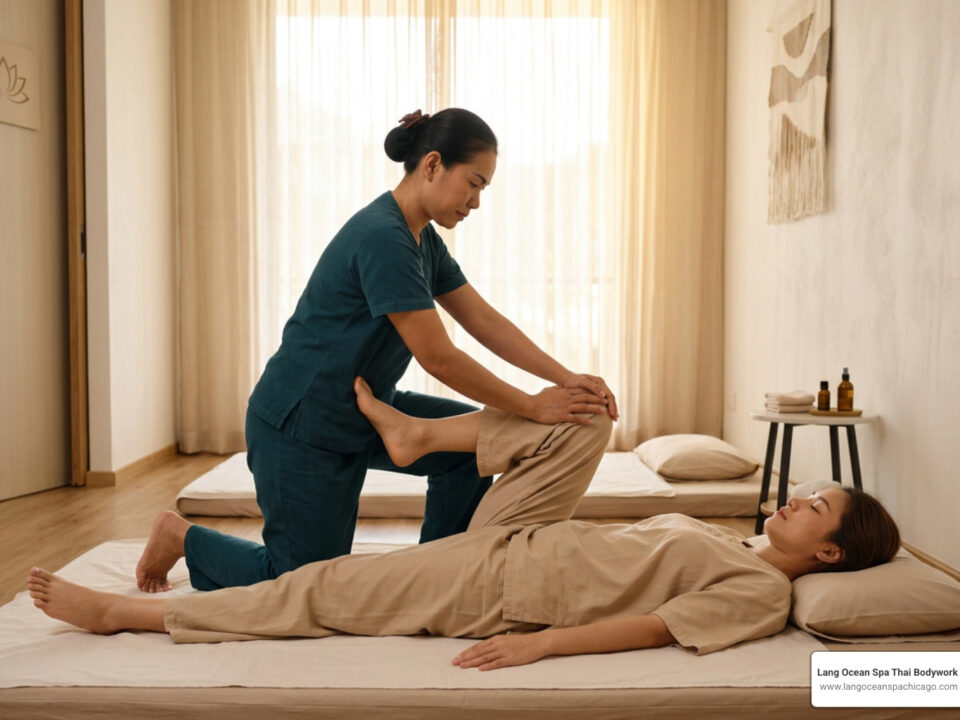
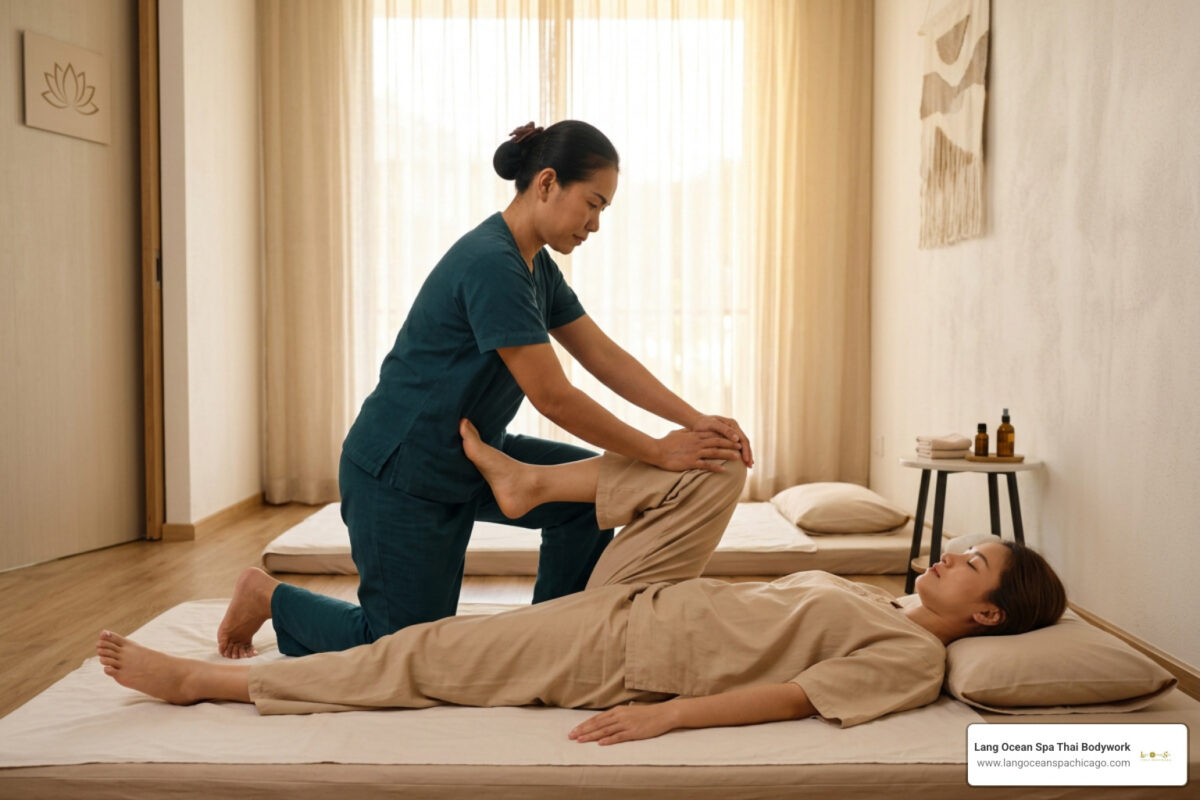
The differences begin with the physical setup. Rather than undressing and climbing onto a high, padded table, you remain fully clothed in lightweight, loose-fitting garments and lie down on a comfortable, cushioned mat placed directly on the floor. This floor-based setup is crucial because it allows the therapist to use their own body weight, leverage, and gravity to perform deep stretches and apply consistent, controlled pressure.
Another major difference is the lack of lubrication. Unlike Swedish or deep tissue therapies, traditional Thai massage is a “dry” massage — no oils, creams, or lotions are applied to your skin. This ensures the therapist’s hands, feet, and knees have a secure grip on your clothing as they guide your body through various positions.
Furthermore, while Swedish massage relies on long, gliding strokes (effleurage) and kneading (petrissage) to relax surface muscles, Thai massage focuses on compression, acupressure, joint mobilization, and deep, passive stretching.

To help you visualize these differences, we have mapped out how these popular modalities compare side-by-side:
| Feature | Traditional Thai Massage | Swedish Massage | Deep Tissue Massage |
|---|---|---|---|
| Attire | Fully clothed (loose, flexible clothing) | Undressed (properly draped with sheets) | Undressed (properly draped with sheets) |
| Medium | Dry (no oils or lotions) | Oils, lotions, or creams | Oils, lotions, or creams |
| Equipment | Padded floor mat | Elevated massage table | Elevated massage table |
| Primary Focus | Energy lines (sen), flexibility, joint mobility, full-body alignment | Relaxation, superficial muscle tension, circulation | Chronic muscle knots, deep structural alignment |
| Techniques | Rhythmic compression, acupressure, assisted yoga stretches | Gliding strokes, kneading, tapping, friction | Intense static pressure, slow strokes across muscle fibers |
| Therapist Tools | Hands, thumbs, elbows, forearms, knees, and feet | Hands, thumbs, and forearms | Hands, thumbs, forearms, and elbows |
At Lang Ocean Spa Thai Bodywork, we understand that every individual’s body has unique needs. Whether you are looking for the dynamic stretches of a traditional session or prefer a customized blend of different modalities, you can view our full range of professional offerings on our Services page.
Core Techniques and Principles of Traditional Thai Bodywork

The magic of Thai massage lies in its unique combination of physical and energetic techniques. Rather than focusing solely on isolated muscle groups, the practitioner treats the body as an interconnected system. By combining rhythmic compression with deep, passive stretches, the therapy releases tension from head to toe, leaving you with a profound sense of physical space and mental clarity.
Working with Sen Energy Lines
The foundation of traditional Thai bodywork is the concept of sen lines, which are internal energy pathways that run throughout the body. This system is highly detailed, mapping out 72,000 individual channels through which vital life force energy (known as Lom or Prana) flows.
In everyday practice, therapists focus primarily on the ten major pathways, known as the Sib Sen (the Ten Sen). These pathways originate around the navel and branch out across the entire body, terminating at the extremities. When you experience physical pain, emotional stress, or illness, it is viewed in Traditional Thai Medicine as a blockage or stagnation of energy within these lines.
To clear these blockages, practitioners apply targeted acupressure and rhythmic compression along the sen lines. They do not just use their hands; depending on the level of pressure required, a skilled therapist will use their thumbs, palms, forearms, elbows, knees, and even their feet to press, rock, and stimulate these pathways. This rhythmic pressing helps to release muscular tension, improve blood circulation, and restore the natural flow of positive energy.
For an in-depth, academic look at how these energetic pathways correlate with Western anatomical structures, you can read the textbook frontmatter of Thai Massage: A Traditional Medical Technique (Mosby’s Massage Career Development) .
The Art of Assisted Yoga Postures
Often referred to as “lazy man’s yoga” or “assisted yoga,” Thai massage incorporates a wide variety of passive stretching techniques. During a session, you do not need to hold any poses or exert any physical effort. Instead, you relax completely while the therapist gently lifts, folds, twists, and pulls your body into various yoga-like positions.
These stretches are designed to open up tight joints, lengthen shortened muscles, and improve your body’s overall range of motion. The practitioner uses their own body to stabilize yours, creating safe, deep, and highly effective stretches that would be difficult to achieve on your own.
As the therapist moves you through these gentle, wave-like sequences, your joints undergo passive mobilization. This stimulates the production of synovial fluid, which lubricates your joints and helps reduce stiffness. Whether you are an athlete looking to improve your flexibility or someone dealing with the daily stiffness of a sedentary office job, these assisted postures work wonders for restoring natural, pain-free mobility.
The Health Benefits and Potential Risks of Thai Massage
Because Thai massage addresses both the physical structures of the body and its energetic pathways, the benefits of regular sessions are wide-ranging. From relieving chronic physical pain to calming an overactive nervous system, this ancient therapy offers powerful support for modern health challenges.
Science-Backed Benefits of Thai Massage
While traditional healers have known the benefits of Nuad Thai for centuries, modern clinical research is increasingly validating these claims. Studies have shown that this therapy can have a profound impact on several common health conditions:
- Relief from Chronic Tension Headaches: If you suffer from chronic tension headaches or migraines, Thai massage can offer significant relief. A clinical study found that a series of nine sessions over a three-week period dramatically reduced headache intensity, with therapeutic benefits lasting from several days up to 15 weeks.
- Reduction of Lower Back Pain: Back pain is one of the most common reasons people seek bodywork. A 2017 clinical study conducted in Thailand involving 120 participants with non-specific low back pain demonstrated that twice-weekly Thai massage sessions over four weeks provided significant pain relief, performing comparably to other conservative medical management techniques.
- Eased Joint Stiffness and Osteoarthritis: Thai massage has been shown to improve joint function and reduce pain in people living with joint issues. In a study of 60 patients with knee osteoarthritis, receiving three weeks of traditional Thai massage provided pain relief equivalent to taking daily doses of ibuprofen, but without the potential gastrointestinal side effects.
- Lowered Stress and Anxiety: The rhythmic, meditative nature of the therapy helps soothe the sympathetic nervous system (the “fight-or-flight” response) and activate the parasympathetic nervous system (the “rest-and-digest” response). A small study in 2015 reported that individuals who received a traditional Thai massage tested significantly lower on standardized measures of psychological stress immediately following their treatment.
- Increased Energy and Mental Focus: While Western relaxation massages often leave you feeling sleepy, Thai massage is known for its dual effect. Because it stimulates circulation and clears energy pathways, a 2018 study found that Thai massage significantly increased mental invigoration and physical energy levels compared to Swedish massage.
- Enhanced Athletic Performance: The combination of deep stretching and compression helps flush metabolic waste from muscle tissues. In a study involving 34 soccer players, those who received three Thai massage sessions over a ten-day period showed marked improvements in vertical jump tests and overall physical flexibility, making it an excellent tool for workout recovery.
For a comprehensive medical perspective on how these benefits can support your wellness journey, check out the clinical overview on Thai Massage: What It Is and 5 Benefits .
Who Should Avoid Thai Massage?
While Thai massage is highly therapeutic for most people, its dynamic, deep-pressure, and stretching techniques mean it is not suitable for everyone. Because the therapist moves your body through various positions, certain medical conditions require caution or absolute avoidance.
You should consult your primary healthcare provider before booking a session if you have any of the following conditions:
- Cardiovascular diseases, high blood pressure, or a history of blood clots (such as Deep Vein Thrombosis)
- Osteoporosis, severe arthritis, or spinal conditions (such as herniated discs)
- Diabetes, which can affect skin sensitivity and circulation
- Active cancer or undergoing cancer treatments
- Recent surgeries, open wounds, severe burns, or bleeding disorders
A Note on Pregnancy: Traditional Thai massage is generally not recommended for pregnant individuals. The deep abdominal compressions, intense twisting postures, and specific acupressure points along the lower body can carry risks during pregnancy. If you are expecting, we highly recommend opting for a specialized prenatal massage instead, which is tailored specifically to keep you and your baby safe and comfortable.
What to Expect During Your Session
If you are booking your very first Thai massage, knowing what to expect can help you feel completely comfortable and prepared to relax.
When you arrive at our tranquil Chicago day spa, you will be greeted by our warm, professional team. We will guide you to a private or semi-private treatment room designed with peaceful, traditional aesthetics. Instead of a high table, you will see a comfortable, wide, and supportive mattress placed on the floor.
You will remain fully clothed throughout the entire session. We provide clean, comfortable, loose-fitting cotton spa wear (a loose t-shirt and wide-leg drawstring pants) for you to change into. This clothing is specifically designed to allow your limbs to bend, stretch, and move freely without restriction.
A typical session lasts anywhere from 60 to 120 minutes, though we highly recommend a 90-minute or 120-minute session to allow the practitioner to thoroughly work through your entire body without rushing. To view our current rates and find a session length that fits your schedule, you can check our detailed Pricing page.
Preparing for Your Appointment
To get the absolute most out of your session, we recommend keeping a few simple preparation tips in mind:
- Avoid Heavy Meals: Because Thai massage involves twisting, bending, and deep abdominal pressure, we recommend avoiding large meals for at least one to two hours before your appointment. A light snack is perfectly fine.
- Arrive Hydrated: Drinking water beforehand helps prepare your muscles for stretching and assists your lymphatic system in flushing out metabolic waste.
- Communicate Openly: Before your session begins, speak with your therapist about your current physical condition. Let them know about any areas of pain, tightness, recent injuries, or if you have a preference for light, medium, or deep pressure.
- Breathe and Let Go: During the stretches, remember to breathe deeply and naturally. Try not to resist or tense up your muscles; the more you can relax and let the therapist support your weight, the deeper and more beneficial the stretches will be.
Finding a skilled, intuitive therapist is key to having a safe and deeply restorative experience. If you want to learn how to identify top-tier talent in the industry, check out our guide on Thai Massage 101: Spotting a Highly Experienced Masseuse Before You Book.
Training and Certification Standards
Because Thai massage is a highly specialized medical art, proper training is essential for practitioner safety and effectiveness. In Thailand, the practice is closely regulated by the Ministry of Public Health’s Department of Health Service Support (HSS).
To become a licensed traditional massage practitioner in Thailand, an individual must complete a rigorous training curriculum consisting of at least 800 hours of study. This extensive training covers human anatomy, physiology, traditional Thai medical theory, specific sen line pathways, and safe stretching mechanics.
While the spa industry in Thailand is vast — with estimates of 8,000 to 10,000 massage shops nationwide — only a portion are officially certified under these strict government standards (with 4,228 certified as of 2018). Furthermore, as of 2016, there were 913 highly specialized traditional medical clinics registered nationwide.
At Lang Ocean Spa Thai Bodywork, we bring these exact high standards of authentic, safe, and professional training to our Chicago locations in River North, Lincoln Park, and Streeterville. Our therapists are deeply experienced, ensuring that every stretch, twist, and point of pressure is applied with anatomical precision and genuine care.
Frequently Asked Questions About Thai Massage
We want you to feel completely confident before you step through our doors. Here are answers to some of the most common questions our clients ask about Thai massage:
Does Thai massage hurt?
A traditional Thai massage should never be painfully unbearable. Because the therapist works deep into tight muscles and energy lines, you may experience a sensation often described as a “good hurt” — a deep, therapeutic pressure that releases built-up tension.
However, everyone’s pain tolerance is different. Our therapists are trained to continuously check in with you and adjust their pressure accordingly. If a stretch or pressure point ever feels too intense, simply let your therapist know right away, and they will gladly soften their touch.
What should I wear to my session?
You do not need to bring any special clothing with you! We provide clean, comfortable, and breathable loose-fitting cotton spa garments for you to wear during your session.
If you prefer to wear your own clothes, we recommend bringing loose athletic wear, such as a soft t-shirt and flexible sweatpants or yoga pants. Please avoid wearing stiff fabrics like denim, skirts, or clothing with restrictive belts, zippers, or buttons.
How often should I get a Thai massage?
The ideal frequency depends entirely on your personal wellness goals:
- For General Maintenance and Stress Relief: A monthly session is a fantastic way to manage daily stress, keep your joints loose, and maintain optimal flexibility.
- For Chronic Stiffness or Desk Job Recovery: If you sit at a computer all day and struggle with chronic neck, shoulder, or lower back tightness, we recommend coming in every two weeks.
- For Athletic Recovery or Injury Relief: If you are training or recovering from muscle fatigue, weekly sessions can help speed up your recovery time and restore full range of motion.
Conclusion
In our , high-stress world, finding a true sanctuary where you can step away from the noise and deeply restore your body is essential. Thai massage offers a time-tested, holistic pathway to physical relief and mental peace. By combining the therapeutic benefits of acupressure, joint mobilization, and deep, assisted yoga stretches, this ancient practice does not just relax your muscles — it revitalizes your entire life force.
At Lang Ocean Spa Thai Bodywork, we are proud to offer authentic, high-quality, and affordable traditional Thai bodywork in a tranquil, welcoming environment. Whether you are looking to ease chronic back pain, improve your physical flexibility, or simply escape the daily grind, our expert team in River North, Lincoln Park, and Streeterville is here to support you.
We understand that life gets busy, which is why we make self-care easy with convenient same-day appointments. You can view our open times on our Schedule page, learn more about our philosophy on our About page, or get in touch directly via our Contact page.
Ready to give your body the deep reset it deserves? Book Now to schedule your session today and experience the incredible, life-changing benefits of authentic Thai massage for yourself.