What Is Thai Therapeutic Massage — and Why Does It Work?
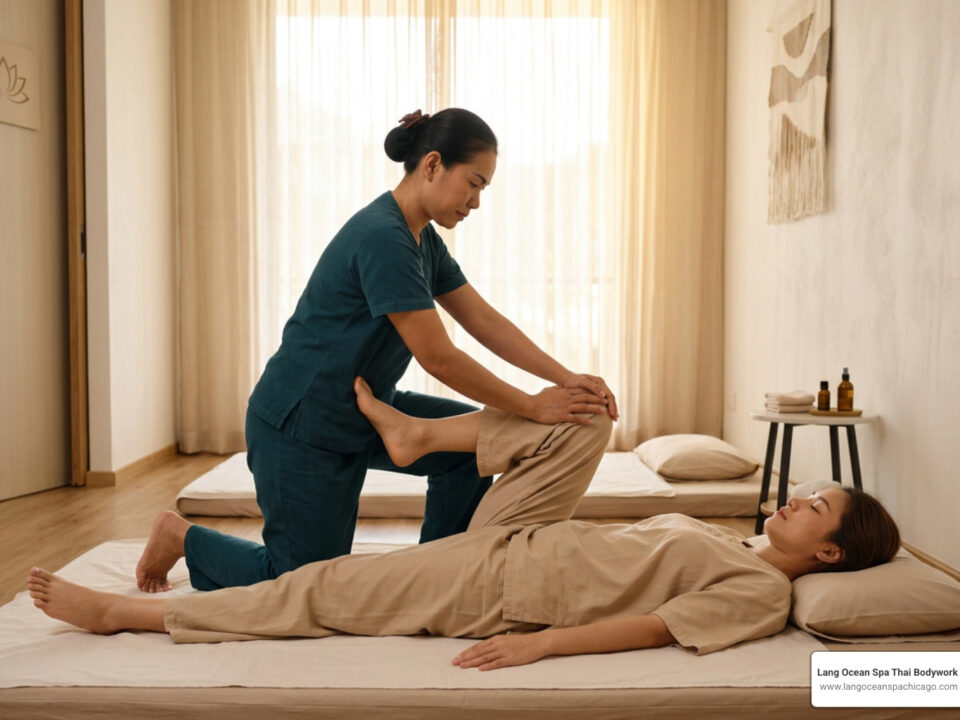
Thai therapeutic massage is an ancient, movement-based healing practice that combines assisted stretching, rhythmic compression, and joint mobilization — performed fully clothed on a floor mat, without oils — to relieve tension, improve flexibility, and restore balance to the body.
Here’s a quick overview of what makes it unique:
| Feature | Thai Therapeutic Massage |
|---|---|
| Origin | Thailand, rooted in Buddhist and Ayurvedic traditions (~2,500 years ago) |
| Setting | Floor mat, fully clothed, no oils |
| Core techniques | Assisted stretching, compression, joint mobilization |
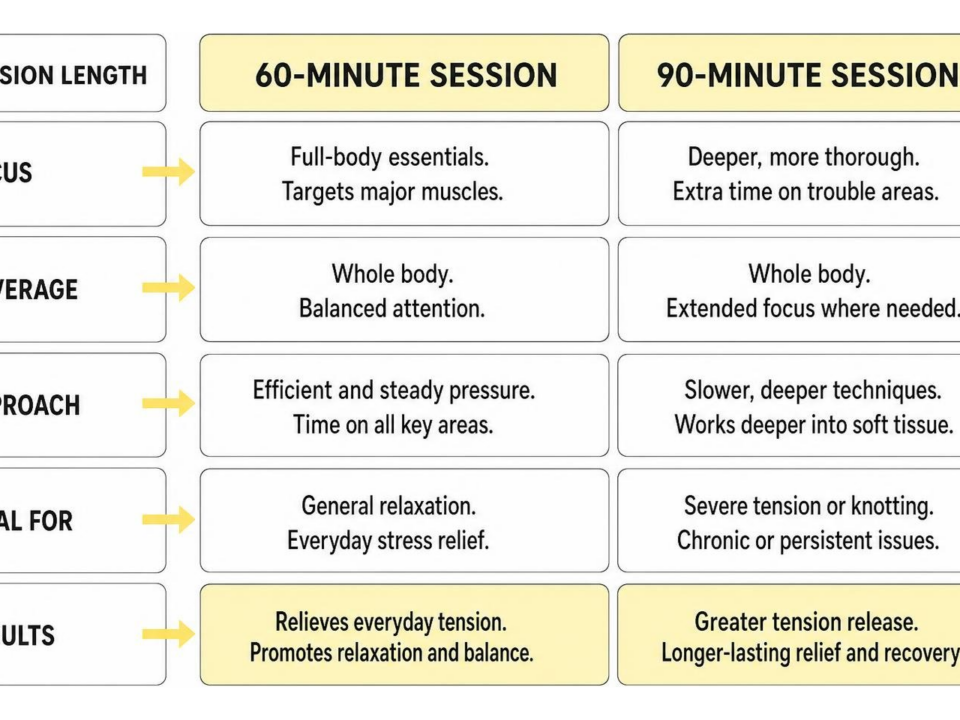
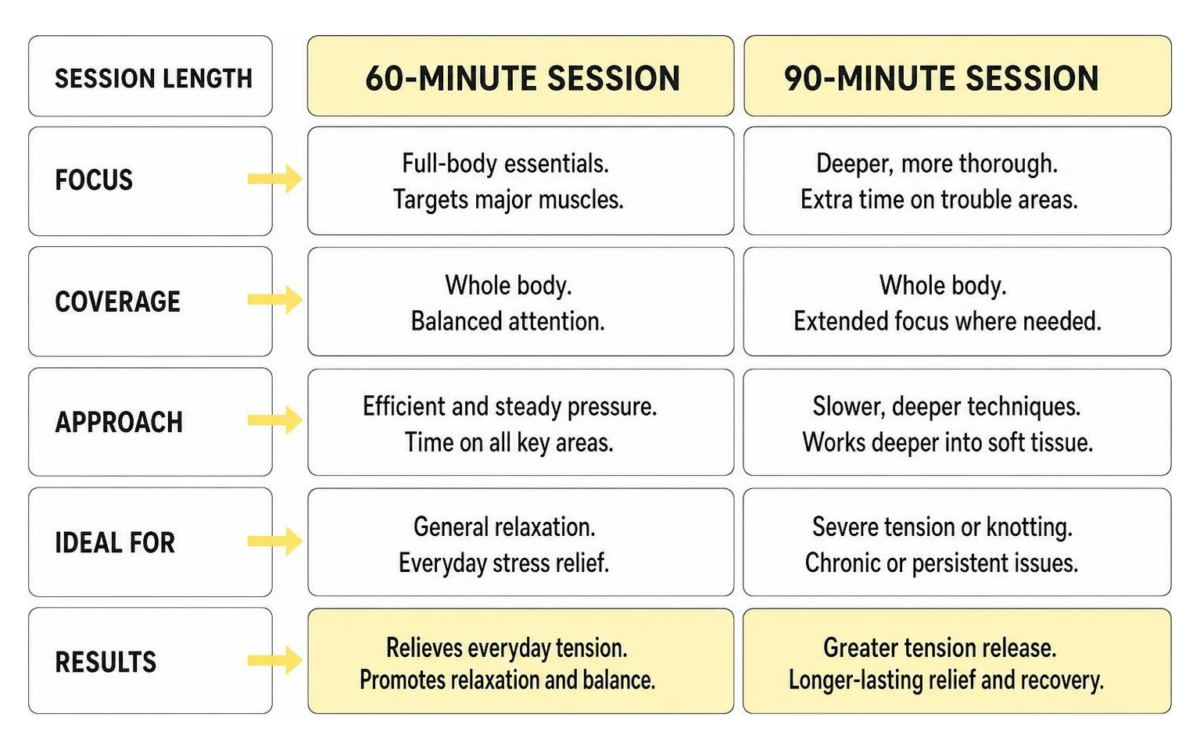
| Session length | Typically 90 minutes |
| Key benefits | Reduced tension, improved flexibility, better circulation, stress relief |
| Best for | Office workers, athletes, anyone with chronic stiffness or stress |
If you spend long hours at a desk, you already know the feeling — tight shoulders, a stiff neck, that low-grade ache that never quite goes away. Conventional massage can help, but Thai bodywork goes further. Rather than simply pressing on muscles, it moves your whole body through a guided sequence of stretches and pressure points that loosen what’s locked and wake up what’s gone quiet.
Think of it as assisted yoga, delivered by a trained therapist who does the work while you simply breathe and let go.
I’m June Liu, founder of Lang Ocean Spa Thai Bodywork in Chicago, and I’ve spent nearly a decade helping clients experience the real, lasting benefits of Thai therapeutic massage — from first-timers nervous about stretching to seasoned athletes chasing better recovery. In the guide below, I’ll walk you through everything you need to know, from the science and history behind the practice to what to wear and what to expect on your first visit.
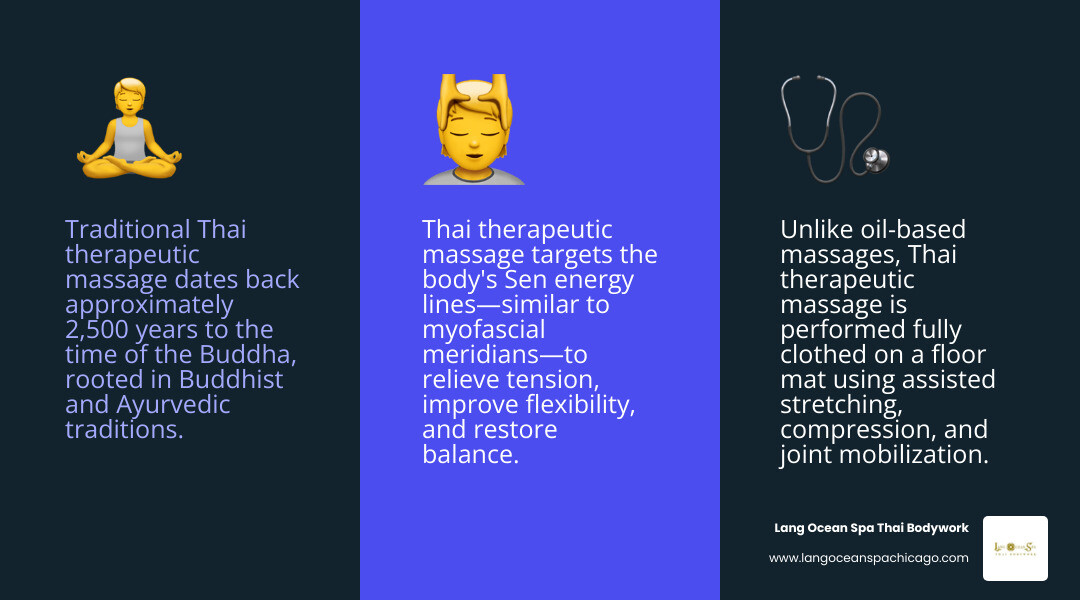
Key terms for thai therapeutic massage:
What is Traditional Thai Massage?
To truly appreciate thai therapeutic massage, we have to look at its roots. Known in Thailand as Nuat Thai or Nuat phaen thai (literally “Thai-style massage”), this is not just a spa luxury. It is a highly respected branch of Traditional Thai Medicine that has been practiced for over two and a half millennia.
The historical founder of Thai medicine and massage is Jīvaka Komārabhacca, an extraordinary physician who lived over 2,500 years ago and is revered as the personal doctor to the Buddha. Because of these ancient origins, the practice evolved within Buddhist temples, where monks integrated physical bodywork with spiritual mindfulness.
When a skilled practitioner performs traditional Thai massage, they are not just executing physical movements. They are practicing metta — the Buddhist concept of loving-kindness. The session becomes a dual-meditative experience, a quiet, flowing dance where both the giver and the receiver focus on breathing, presence, and healing.
Over the centuries, the Thai people absorbed Indian Ayurvedic principles, yoga postures, and Chinese meridian theories, refining them into a unique medical system. This rich cultural legacy is so significant that in December 2019, UNESCO officially added traditional Thai massage to its Intangible Cultural Heritage of Humanity list. To learn more about its global recognition and historical records, you can check out the comprehensive Traditional Thai massage – Wikipedia page.
To understand how this active style differs from what you might find at a typical Western day spa, let’s look at a quick comparison:
| Feature | Traditional Thai Massage | Swedish / Western Massage |
|---|---|---|
| Primary Goal | Restore energy flow, improve flexibility, and mobilize joints | Relax local muscle tissues and relieve tension |
| Client Attire | Fully clothed in loose, comfortable garments | Undressed (draped with a sheet or towel) |
| Medium Used | None (no oils, lotions, or creams) | Massage oils, lotions, or body butters |
| Surface | Firm floor mat or low, wide mattress | Elevated, cushioned massage table |
| Therapist Tools | Thumbs, palms, elbows, knees, feet, and body weight | Hands, fingers, forearms, and elbows |
| Movement | Active-passive assisted stretching and rhythmic rocking | Passive gliding, kneading, and friction strokes |
By stepping away from the table and ditching the oils, Thai bodywork allows for a much wider range of motion. If you want to dive deeper into how these unique physical movements help you let go of daily worries, read our guide on How Thai Massage Can Help You to Unwind.
The Science and Philosophy Behind Thai Therapeutic Massage
Traditional Thai medical theory teaches that the body is crisscrossed by a network of invisible energy pathways called Sen lines. While there are thousands of these channels, therapeutic work focuses primarily on ten major pathways, collectively known as the Sen Seb lines (or the ten Sen).
If you are skeptical about “energy lines,” you are not alone! However, modern anatomy has revealed a fascinating parallel: these ancient Sen lines align remarkably well with Western medicine’s myofascial meridians. Fascia is the continuous web of connective tissue that wraps around our muscles, bones, and organs. When a therapist applies pressure along a Sen line, they are actually releasing tension along a myofascial pathway, which explains why a stretch in your hips can suddenly relieve a dull ache in your lower back.
To learn more about how Eastern energy concepts bridge with Western physical therapy, you can explore the textbook excerpt Thai Massage: A Traditional Medical Technique (Mosby’s Massage Career Development).
At Lang Ocean Spa Thai Bodywork, we combine these traditional concepts with modern clinical understanding to support your overall Wellness and Healing. Two traditional techniques illustrate this beautiful intersection of science and philosophy:
The Five-Phase Pulse
When performing acupressure along the Sen lines, traditional practitioners do not just press randomly. They use a rhythmic, orthogonal pressing technique known as the “five-phase pulse.” This consists of:
- Contact – Gently placing the hand or thumb on the target muscle.
- Push – Applying initial downward pressure.
- Pin – Holding the pressure at its deepest point to target the muscle axis.
- Press – Securing the hold to encourage the tissue to release.
- Remove contact – Slowly releasing the pressure to let blood rush back.
Opening the Wind Gates
Another signature technique is “opening the wind gates” (Perd-Pra-Tu-lom). To do this, a practitioner applies gentle, localized pressure over a major artery (such as the femoral artery in the groin or the brachial artery in the inner arm) for up to 45 seconds. This temporarily restricts blood flow. When the pressure is gradually released, it triggers a physiological phenomenon known as reactive hyperemia — a sudden, powerful surge of warm, oxygen-rich blood rushing back into the limb, flushing out metabolic waste and nourishing the muscles.
Core Techniques: Stretching, Compression, and Mobilization
During a session, your therapist will seamlessly weave together three core modalities:
- Assisted Stretching: Often called “passive yoga,” your therapist will guide your limbs into deep, therapeutic stretches (such as spinal twists, hamstring extensions, and chest openers) while you remain completely relaxed.
- Rhythmic Compression: Using their thumbs, palms, and sometimes forearms or feet, the therapist applies steady pressure along muscle fibers to soften tight tissues.
- Joint Mobilization: Gentle rocking and pulling movements help lubricate your joints, increasing the production of synovial fluid to reduce friction and stiffness.
Because this is a highly physical practice, the therapist must use excellent body mechanics, utilizing their own body weight and leverage rather than brute muscular force. This ensures the pressure is deep, steady, and incredibly therapeutic.
Key Health Benefits of Thai Bodywork
Because thai therapeutic massage is so dynamic, its physiological benefits extend far beyond a typical relaxation massage. By combining targeted pressure with deep stretching, it systematically improves:
- Flexibility and Range of Motion: Over time, sedentary lifestyles cause muscles to shorten and joints to stiffen. Thai massage gently coaxes your muscles back to their natural lengths.
- Posture and Body Alignment: By releasing tight hip flexors, chest muscles, and hamstrings, your body can naturally return to its neutral, upright alignment, reducing the strain on your spine.
- Circulation and Lymphatic Flow: The combination of compression, stretching, and “opening the wind gates” stimulates blood circulation and lymphatic drainage, helping your body process metabolic waste more efficiently.
These benefits are not just theoretical; they are backed by rigorous scientific research. For example, a landmark study published in BMC Complementary Medicine and Therapies investigated the physiological impacts of Court-type Thai traditional massage (a formal style historically practiced in the royal court, which utilizes only thumbs, fingers, and palms).
The researchers performed cadaveric dissections on 83 subjects to verify the anatomical safety of neck massage, proving that the major pressure points used in Thai massage are safely separated from the common carotid arteries. Furthermore, using Duplex ultrasound on healthy volunteers, they demonstrated that applying pressure to these points caused a significant, immediate increase in blood flow within 30 to 60 seconds, followed by a gradual increase in skin temperature after 300 seconds. For a detailed look at the data, you can read the full study: The effects of the court-type Thai traditional massage on anatomical relations, blood flow, and skin temperature of the neck, shoulder, and arm.
Relieving Office Syndrome and Chronic Back Pain
If you sit at a computer in River North or Streeterville all day, you are likely intimately acquainted with Office Syndrome. This modern ailment is characterized by chronic muscle spasms, tension headaches, and active myofascial trigger points in the upper trapezius, neck, and lower back due to prolonged, static posture.
Clinical research has shown that a standardized 90-minute traditional Thai massage protocol is incredibly effective at treating these symptoms. In a clinical trial, patients suffering from Office Syndrome underwent a structured 25-step protocol (consisting of 20 pressing steps along the Sen Seb lines, 2 artery occlusions, and 3 stretching steps).
The results were remarkable:
- Pain Reduction: Patients experienced an average pain intensity drop of 2.33 cm on a 10 cm Visual Analogue Scale (VAS).
- Increased Pain Threshold: The pressure required to trigger pain (Pain Pressure Threshold) increased by 0.37 kg/cm², meaning their muscles became significantly less sensitive and inflamed.
- High Satisfaction: Both therapists and patients reported confidence and satisfaction scores exceeding 80%.
You can review the exact clinical steps and trial data in the published study: Standardised 25-Step Traditional Thai Massage (TTM) Protocol for Treating Office Syndrome (OS).
Who is This Active Bodywork Best Suited For?
Thai therapeutic massage is a fantastic option for a wide variety of people, but it is especially beneficial if you fall into one of these categories:
- Office Workers and Desk Dwellers: If you spend your days hunched over a laptop, the deep chest-opening stretches and shoulder compressions of Thai massage are the perfect antidote to “computer slouch.”
- Athletes and Fitness Enthusiasts: Whether you are running along the Lakefront Trail or lifting weights, Thai bodywork acts as a form of active recovery, flushing out lactic acid and restoring flexibility to tight muscle groups.
- Yoga Practitioners: If you love yoga but want to experience deeper, passive variations of your favorite postures, a Thai massage feels like a personalized, hands-on yoga class where you don’t have to balance on one leg.
If you are ready to find relief from daily wear and tear, we invite you to Find the Best Full Body Massage Near You at our peaceful Chicago locations.
Who Benefits Most from a Thai Therapeutic Massage?
While anyone looking to unwind can enjoy this therapy, those who benefit most are individuals with specific mobility goals or chronic, stubborn stiffness. If standard table massages leave you feeling relaxed but still physically tight, the active, joint-mobilizing nature of Thai bodywork is likely exactly what your body is craving.
To see how we rank among local options, check out our guide on Chicago’s Top Reviewed Thai Massages from Budget Spas to Luxury Retreats.
Contraindications and Safety Precautions
While Thai massage is highly therapeutic, its active stretching and deep pressure mean it is not suitable for everyone. You should avoid Thai massage or consult with your primary care physician before booking if you have any of the following conditions:
- Severe heart disease or uncontrolled high blood pressure (hypertension)
- Osteoporosis or severe bone density loss
- Deep vein thrombosis (DVT) or blood clotting disorders
- Active cancer or undergoing cancer treatments
- Pregnancy (traditional stretching and deep pressure are contraindicated, though specialized prenatal massage is available)
- Recent surgeries, acute joint inflammation, or unhealed bone fractures
- Uncontrolled diabetes (which can affect skin sensitivity and circulation)
Always communicate openly with your therapist about your medical history before your session begins.
Preparing for Your Session: A Client’s Guide
If you are used to Western table massages, your first thai therapeutic massage will be a completely different — and wonderful — experience. Here is how to prepare so you can get the most out of your session.
First, you will not undress. You will remain fully clothed throughout the treatment. We recommend wearing loose, lightweight, and comfortable clothing that allows for a full range of motion — think yoga pants, sweatpants, and a soft t-shirt. Avoid tight jeans, restrictive athletic wear, or shirts with stiff collars or buttons.
Second, the massage takes place on a comfortable, cushioned floor mat or a very low, wide massage mattress rather than a narrow table. This setup gives your therapist the space and leverage they need to move around you, safely guiding your body into various stretches.
Finally, this is a partnership. Your therapist will guide your body, but you need to be an active participant through deep breathing and open communication. To make sure you book with someone who truly understands this delicate balance, read our tips on Thai Massage 101: Spotting a Highly Experienced Masseuse Before You Book.
What to Expect During Your First Thai Therapeutic Massage Session
When you arrive at Lang Ocean Spa Thai Bodywork, your therapist will guide you to your mat. A typical session lasts about 90 minutes to allow the body to fully warm up, relax, and stretch.
Because no oils or lotions are used, your therapist will maintain a firm, secure grip as they gently rock, compress, and stretch your body. They will use their hands, thumbs, palms, and occasionally their elbows or knees to apply pressure, using their own body weight as a counter-lever to deepen your stretches.
As they move you into passive yoga poses, focus on slow, deep abdominal breathing. If a stretch ever feels too intense, simply let your therapist know. The experience should feel like a deep, satisfying release — never painful.
Enhancing and Combining Your Treatment
While traditional Thai massage is incredibly complete on its own, it can also be customized and combined with other holistic treatments to target your specific wellness goals.
At Lang Ocean Spa Thai Bodywork, we offer several ways to customize your session:
- Aromatherapy: Integrating soothing essential oils (like lavender, eucalyptus, or lemongrass) into the room’s atmosphere to calm your nervous system and deepen your mental relaxation.
- Reflexology: Adding targeted pressure point work on the feet to stimulate nerve pathways and restore balance to your internal organs.
- Soundbath Therapy: Incorporating the gentle, resonant vibrations of singing bowls to help quiet a busy mind and ease you into a deeply meditative state.
- Customized Pressure: Whether you prefer soft, soothing pressure or firm, deep-tissue compression, our therapists will adapt their touch to match your comfort level.
To view our full menu of custom options, visit our Services page.
Frequently Asked Questions about Thai Massage
How often should you get a Thai massage?
For general stress relief and flexibility maintenance, we recommend scheduling a session once or twice a month. If you are an athlete in heavy training or are actively working to recover from chronic stiffness or Office Syndrome, weekly sessions can accelerate your recovery. You can check out our affordable options on our Pricing page.
Does Thai massage hurt?
It shouldn’t! While Thai massage involves deep pressure and intense stretches, it should always remain within your “good hurt” zone — that sweet spot where you feel a deep, satisfying release of tension. If you ever feel sharp pain or find yourself tensing up or holding your breath, tell your therapist immediately so they can adjust their pressure or depth.
Why is no oil used in traditional Thai massage?
Traditional Thai massage relies on secure grip and traction to safely perform stretches and joint mobilizations. If the skin were slippery with oil, the therapist’s hands would slide, making it impossible to hold deep stretches or apply precise pressure along the Sen lines. Staying clothed also honors the modest, temple-based origins of the practice.
Conclusion
If you are ready to say “knot today” to chronic stress, tight shoulders, and physical exhaustion, thai therapeutic massage offers a time-tested, scientifically backed pathway to relief. By combining the ancient wisdom of the Sen lines with modern myofascial science, this active bodywork does not just pamper your muscles — it restores your body’s natural movement, alignment, and peace of mind.
At Lang Ocean Spa Thai Bodywork, we are proud to bring authentic, high-quality, and affordable Thai massage to our tranquil, local settings in Chicago. Whether you live or work in River North, Lincoln Park, or Streeterville, our experienced therapists are here to help you move, breathe, and live better. We make prioritizing your health simple with convenient, same-day appointments.
Ready to stretch your stress away? Book Now to reserve your mat, or explore our full range of therapeutic bodywork options on our Services page. We look forward to welcoming you soon!